A Watch Party Built Around a Costume Change
A watch party built around a costume change gives guests one visual detail to follow, turning a familiar screen moment into an easy shared conversation.
The most common mistake in planning a watch party is giving guests too many jobs: bring a dish, dress as a character, know the plot, and arrive ready to debate the ending. The cost is a roomful of people performing enthusiasm instead of enjoying the show. A watch party built around a costume change needs only one shared point of attention, and nobody has to pass a quiz to join in.
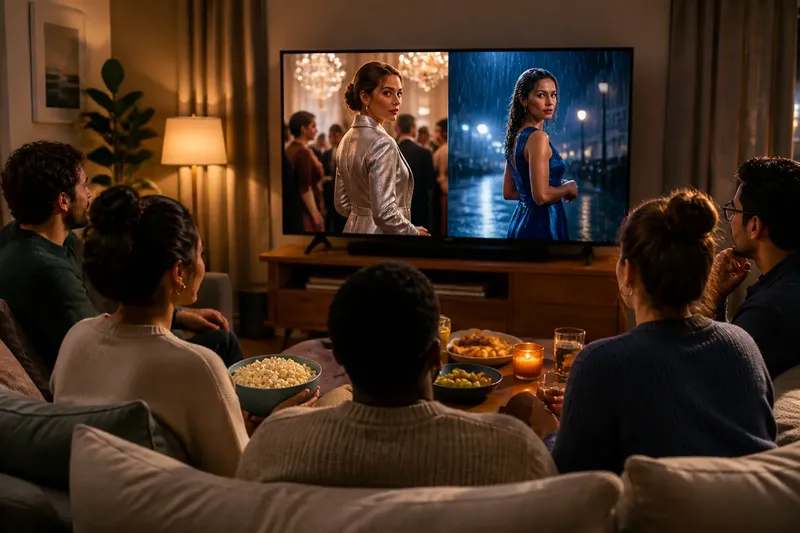
For this invented situation, imagine Mara hosting a Saturday-night viewing of a fictional musical film called Harbor Lights. She wants a social occasion, not a fan convention, and remembers that its lead character changes from a formal silver coat into a rain-soaked blue dress midway through the story. Mara makes that visual shift the evening’s prompt: notice what changes with the clothes, and what does not.
The single visual cue
A costume change works as a prompt because it is visible without requiring specialized knowledge. Guests can talk about color, fabric, movement, mood, or the moment a new outfit appears. They do not need to know who designed it, what a particular stitch means, or whether the garment has a hidden connection to another film.
Mara keeps her invitation plain: “We’re watching Harbor Lights. Keep an eye out for the shift from silver to blue, and bring whatever snack you like.” The note gives the evening a shape without turning clothing into an entrance exam. Guests can dress normally; a silver accessory is optional, not a ticket.
The choice of cue matters. A change should be easy to recognize in the version the group will watch, and it should occur in a scene with enough room for a short conversation afterward. A fleeting outfit in a crowded montage may be memorable to an expert and nearly invisible to someone pouring tea.
Choosing the right scene
Mara checks the film’s chapter list and her own copy before setting the schedule. She looks for the sequence where the silver coat gives way to the blue dress, then notes the scene’s rough position rather than making guests hunt for a frame or replay a clip. If a platform’s version uses different chapter divisions, the visual cue remains more useful than a timestamp.
She also checks whether the change is clear on the screen she plans to use. A dark room, a small laptop display, or a stream compressed into murky colors can flatten details. Mara chooses the living-room television, closes the curtains, and leaves a lamp on behind the seating so guests can see one another without washing out the picture.
That is enough preparation. She does not pause the film for a lecture or print a guide to every outfit. The point is to make a moment more noticeable, not to compete with it.
A room with room to talk
Mara arranges chairs so guests can see the screen and each other. She puts snacks on a side table rather than directly in front of the television, then leaves a small space near the sofa for anyone who wants to stand or step away. People should be able to join late, refill a glass, or simply watch quietly without disrupting the occasion.
Before pressing play, she gives a brief invitation: “When the blue dress appears, notice what the scene feels like before and after. We can talk about it once the sequence ends.” That phrasing offers a way in without dictating a correct interpretation. Someone may notice the character’s posture; someone else may remember the rain, the lighting, or the change in music.
She avoids asking guests to call out every time a costume appears. Constant commentary can turn a film into background noise with a running panel discussion. A single agreed moment gives the group a natural pause, while the rest of the story can play at its own pace.
Questions after the change?
Should guests dress to match the costume?
No. Mara treats a silver or blue detail as an optional nod, not a dress code. The visual prompt belongs to the film, so guests can participate through observation, conversation, or quiet attention.
What if someone has never seen the film?
That is useful, not inconvenient: a first-time viewer can respond to the scene without inherited opinions about it. Mara avoids explaining the plot in advance and gives newcomers the same simple cue as everyone else.
Should the host pause the film?
Only if the group wants a pause and the moment is a natural stopping point. Mara plans to let the sequence finish before asking what people noticed, which avoids interrupting dialogue or making a guest feel put on the spot.
What if the costume change is easy to miss?
Mara gives one gentle reminder just before the relevant stretch of the film, using the character or scene as a cue. If a guest still misses it, there is no need to rewind; the conversation can start with what the rest of the room noticed.
The conversation stays open
In the invented evening, the blue dress appears after the character leaves a bright hotel ballroom and walks into the rain. One guest notices that the loose fabric lets her move more freely; another says the blue reads as quieter than the silver, while a third points out that the character still holds her shoulders stiffly. None of these observations needs to win.
Mara asks what the clothing seems to do in the scene, rather than what it “means” in the abstract. That distinction keeps the discussion grounded in what everyone can see: the shift in color, the wet fabric, the change of setting, and the character’s movement. If someone offers a theory about the costume designer’s intention, the group can treat it as an interpretation rather than a fact about the production.
There is room for disagreement. One guest may see the blue dress as a sign of freedom; another may think the rain makes it look less like a choice and more like a practical consequence of the scene. The host does not need to settle the matter. The useful result is that guests look closely and give reasons for what they see.
Ending without a verdict
When the film ends, Mara lets the closing credits begin before asking whether anyone wants to return to the costume change. A few guests compare the character’s silver and blue looks; another heads for the kitchen. The evening has reached its purpose without requiring a final consensus or a scorecard.
She carries one lesson into future screenings: a good prompt is specific enough to focus attention and loose enough to welcome different responses. A costume change can open a conversation about character, setting, performance, or visual style, but it should not be presented as evidence of a single hidden message. The scene is the shared material; the reading belongs to the room.
For a watch party built around a costume change, the best follow-up is often modest: ask each guest which detail stayed with them, then let the answers stand side by side. That leaves people with something more memorable than a trivia score—the habit of noticing how a screen image changes as the story moves.