From Fan Club Newsletter to Online Fandom
From fan club newsletter to online fandom, trace how fan communication moved from mailed correspondence to visible online exchange without erasing print.
The most common mistake in tracing the fan club newsletter to online fandom is to call the internet a replacement for print; that shortcut loses the quieter work of organizing, editing, and deciding who got to speak. A mailed bulletin and a social platform both connect fans, but they make different demands on time, access, and attention.
Follow the change through the communication itself: who prepared it, how it traveled, when readers could answer, and what became visible to outsiders. That sequence gives a more useful history than treating each new medium as an upgrade to the last.
Start with the mailroom
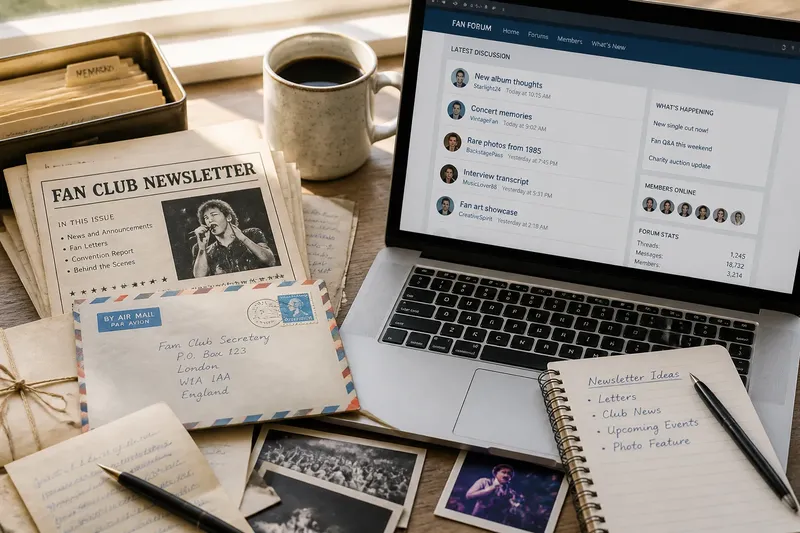
Early fan clubs often depended on a small organizing center. A club secretary or volunteer might collect membership correspondence, prepare a newsletter, and send it through the postal service. The publication could carry notices, fan letters, activity reports, and material related to a performer or program. Its regularity came from labor and postage, not from a platform automatically placing it in front of readers.
Print created a particular social arrangement. Someone selected what to include, made the pages, addressed envelopes, and managed a list of recipients. Readers received the same assembled issue, often at different moments depending on mail delivery. Their replies traveled back along the same route, so a conversation could take shape slowly and through an intermediary.
That delay was not merely a defect. It gave editors room to gather contributions and readers time to compose a letter rather than react in public. It also gave organizers considerable control over the club’s tone and boundaries. If a letter never made the next issue, its absence might be hard for other members to notice.
Read the editorial layer
A newsletter is not a transparent record of everything fans said. It is a selection, shaped by available space, the editor’s judgment, and the club’s purpose. A printed letter could turn an individual response into a shared one, but only after someone chose it for publication.
Look for the marks of that process: recurring columns, membership notices, submission instructions, an editor’s address, or a request for letters on a particular subject. These details show how readers were invited to participate and how much work participation required. A publication that asks for stamped envelopes or typed copy offers a different path into fandom than one that accepts a note from anyone who can reach the editor.
Say you are reading an imagined newsletter in which the editor prints several letters about a singer’s latest television appearance but omits a complaint about the club’s mailing delays. The visible discussion may look unanimous, while the editorial choice and limited page space have narrowed what readers can see. The point is not to assume bad faith; it is to treat the issue as both a fan document and an edited object.
Notice the new channels
As personal computing and networked communication spread, fan exchange took forms beyond the club’s printed pages. Email, bulletin-board systems, mailing lists, forums, and fan-run websites each changed the route between a contribution and its readers. None erased the need for organizers or shared interests. They rearranged the work and made some kinds of response easier to circulate.
Email lists could distribute a message to subscribers without printing and mailing a fresh issue. Forums organized discussion into topics that readers could revisit, while personal websites gave fans space to publish material under their own control. These channels did not all behave alike: a mailing list sent discussion into inboxes, while a forum generally asked readers to visit a shared site.
The shift also changed what counted as a publication. A fan might post a short update, link to another source, or maintain an archive without producing a designed newsletter. Some online spaces retained familiar club functions—announcements, membership identity, and shared correspondence—while others allowed looser participation. The format mattered, but so did who maintained it and who felt welcome there.
Compare pace and visibility
Online exchange made quick replies and broad circulation more feasible, but speed did not make every conversation inclusive or easy to follow. A post could be visible to a large audience, or remain inside a private group. A print issue might be physically passed along, while an online discussion could be copied, linked, searched, or separated from its original context.
Use these questions to compare a particular fan space:
- Who can contribute? Check whether participation depends on club membership, an invitation, account access, or an editor’s approval.
- Who can read it? Distinguish a mailed circulation list or closed group from a public page that anyone can find.
- Who keeps the record? Notice whether the editor, site owner, platform, or individual participants control what remains available.
- How does a reply travel? A letter may reach an editor first; a forum post or social reply may appear beside the original message.
- What can be missed? A printed issue has limited space, while a busy online feed can bury earlier contributions under newer ones.
The answers describe the communication system more accurately than a simple print-versus-digital label. They also reveal that visibility is not the same as influence: a message can be easy to see without changing a club’s decisions or reaching the people it addresses.
Track what carries over
Online fandom inherited practices from older fan communication. Fans still gather around shared enthusiasms, circulate information, make spaces for discussion, and decide how to represent the group. Newsletters, zines, letters, and online posts all depend on people who contribute, edit, moderate, archive, or simply keep showing up.
What changes is the balance between those roles. A print editor may control the contents of an issue, while a forum moderator may set rules without choosing every post. A social platform can host fan conversation while also shaping how posts are ordered and recommended. In each case, ask who has practical control rather than assuming the medium has none.
Print has not vanished just because online exchange is faster. Fan publications and physical correspondence can still offer a considered, bounded form of communication, while digital spaces can connect people who would not share a local club or mailing list. Some groups use both, with a newsletter serving as a lasting record and online channels handling day-to-day conversation.
Questions about fan communication?
Did online fandom replace fan clubs?
No single change removed the club model. Some groups shifted activities online, some kept print or postal contact, and others combined formats according to their members’ preferences.
Why did newsletters matter?
They gave a dispersed group a shared publication and a recurring point of contact. Their edited pages also show how a club shaped its public voice and chose which member contributions to circulate.
What changed most online?
Replies could circulate faster, and more participants could publish without waiting for a central editor to assemble an issue. That greater visibility came with new questions about access, moderation, ownership, and what stays in the record.
How can I read an old fan publication?
Start with its masthead, editor’s notes, submission rules, and notices about membership or distribution. Then distinguish what the publication says from what its selection and format make visible; if it is held in an archive or library, use the catalog description to understand its provenance.
Keep the media in view
To understand the history from fan club newsletter to online fandom, follow a message from its contributor to its audience and note every handoff. The editor, postal route, list owner, forum moderator, and platform may each shape who encounters it and how it can be answered.
That approach keeps the history practical rather than nostalgic. A newsletter was not automatically intimate, and a public feed is not automatically democratic; each is a set of choices about access, editing, and attention. The most revealing question is often not which medium came next, but who could make a contribution count once it arrived.