What a Press Kit Is Designed to Do
A press kit gives journalists a usable introduction to an entertainer or project, with selected facts and images that clarify what to cover and where to begin.
The most common press-kit mistake is treating it as a complete biography, then wondering why editors cannot quickly tell what the story is. A press kit is designed to make a person or project legible at a glance: it gathers selected facts, images, and contacts so a journalist can begin reporting without mistaking a publicity introduction for the whole account.
One introduction, several jobs
A press kit is a package of materials assembled for media use. For an actor, musician, producer, or entertainment project, it may include a short biography, a project description, approved photographs, credits, and a publicity contact. Its job is not to settle every question about the subject. It gives a reporter a clear starting point and makes basic information easier to verify.
That distinction matters because publicity material has a point of view. The biography selects which credits come first; the project description emphasizes certain themes; the photographs present a chosen image. Those choices can be useful and accurate without being neutral or complete. A reporter can use the package to understand how a subject is being introduced, then decide what else the story needs.
Think of a press kit as a doorway with a sign, not a floor plan of the entire building. Its usefulness depends on whether the right person can find the relevant material quickly and tell what each item is for.
Three package approaches
The compact digital kit
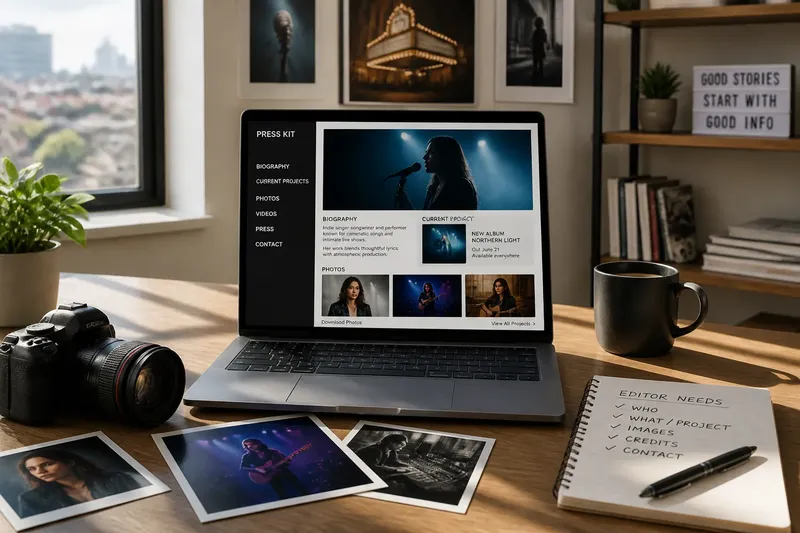
A compact digital kit usually lives on a press page or in a clearly organized folder. It might contain a concise biography, a current project synopsis, a small set of downloadable images, captions, and a contact address. This approach suits an independent performer, a small production, or anyone whose media needs are focused and whose information changes only occasionally.
Its strength is speed: an editor can scan the page, select a relevant image, and move on. Its weakness is that a single page can become a catchall. Old headshots, outdated credits, and unrelated announcements crowding together turn a quick introduction into a modest archaeological site.
The project-specific kit
A project-specific kit is built around a film, album, tour, series, or production. Alongside a short introduction to the principal participants, it can include a synopsis, credits, production notes, and images tied to that release. It suits a campaign where the project itself is the news and where interview access, screening information, or media assets are organized around one launch.
This format keeps the pitch focused, but its shelf life is limited. A kit assembled for a particular release may not make a useful general introduction later, especially if its opening language assumes that the project is still upcoming.
The layered press room
A larger press room separates materials into sections, such as biography, current projects, image downloads, video, and contact details. It suits a company or established performer with several active projects, recurring announcements, or different media needs. Journalists can take the section relevant to their assignment rather than sorting through one oversized document.
The trade-off is maintenance. A layered collection can look orderly while quietly accumulating obsolete material, so someone must own the task of removing or relabeling it. More folders do not automatically mean more clarity; they can simply give confusion better navigation.
Choose by assignment
The right approach depends on what a journalist is likely to need, how many projects are active, and who can keep the materials current. A useful selection rule is straightforward:
- Choose a compact digital kit when the subject needs a general introduction and a small, stable set of assets.
- Choose a project-specific kit when one release or event is the clear focus of the publicity.
- Choose a layered press room when several projects need separate materials and regular updates.
- Keep a general biography distinct from a campaign biography if the latter emphasizes one particular release.
- Make image captions and credit information easy to locate, so a usable photograph does not arrive without its context.
- Put a real publicity contact in a visible place, rather than hiding it inside a long announcement.
Say an independent singer is releasing an album while still booking interviews about earlier work. A project-specific kit can lead with the album synopsis and current images, while linking to a separate short biography and selected credits. The expected result is that an editor covering the release can find campaign material quickly without assuming the album defines the singer’s entire career.
What belongs inside?
Include information that helps a journalist identify the subject, understand the current project, and request the next useful thing. A concise biography should establish relevant roles and credits without turning into a chronological inventory. A project description should say what the work is and how it is being presented, rather than relying on vague claims about its importance.
Images need practical context: the subject’s name, the photographer or required credit, and a description when the image is not self-explanatory. Separate portrait, performance, and production images when those distinctions help an editor choose. Contact details should identify who can handle interview requests or clarify permissions.
Some material belongs elsewhere. A full personal history, every press mention, and claims about how audiences will respond are rarely needed for an introduction. The press kit can direct a reporter toward a person or project; it should not try to answer questions that require independent reporting.
Questions editors ask?
Is a press kit the same as a press release?
No. A press release announces a particular development, such as a casting notice or release date, while a press kit supplies background and media materials that may support several stories. A campaign can use both, but one does not replace the other.
Does every entertainer need a press kit?
No. Someone with little ongoing media activity may need only a concise biography, a few properly captioned images, and a contact route. A larger package makes sense when it saves journalists time rather than giving them more files to ignore.
Should a press kit include favorable reviews?
Selected reviews may be included when they are relevant and accurately attributed, but they should not be presented as an independent account of the subject. A reporter can treat them as publicity context, not as a substitute for evaluating the work or seeking other perspectives.
How often should the materials change?
Update them when a credit, project status, image permission, or contact changes, and remove details that no longer describe the current offering. The goal is not constant revision; it is avoiding a package that introduces someone through information they would now need to correct.
Keep the edges visible
A good press kit makes its selection visible through clear labels and restrained claims. A short biography is a short biography, a campaign synopsis is about a particular project, and an image is supplied for a defined media use. That clarity lets journalists make informed choices without mistaking a polished introduction for an independent account.
For a reader trying to understand what a press kit is designed to do, the practical test is whether it offers a clean beginning: enough context to identify the subject, enough usable material to support a story, and an obvious route to further questions. The strongest kit does not pretend to contain the whole story; it helps the next person ask a better one.